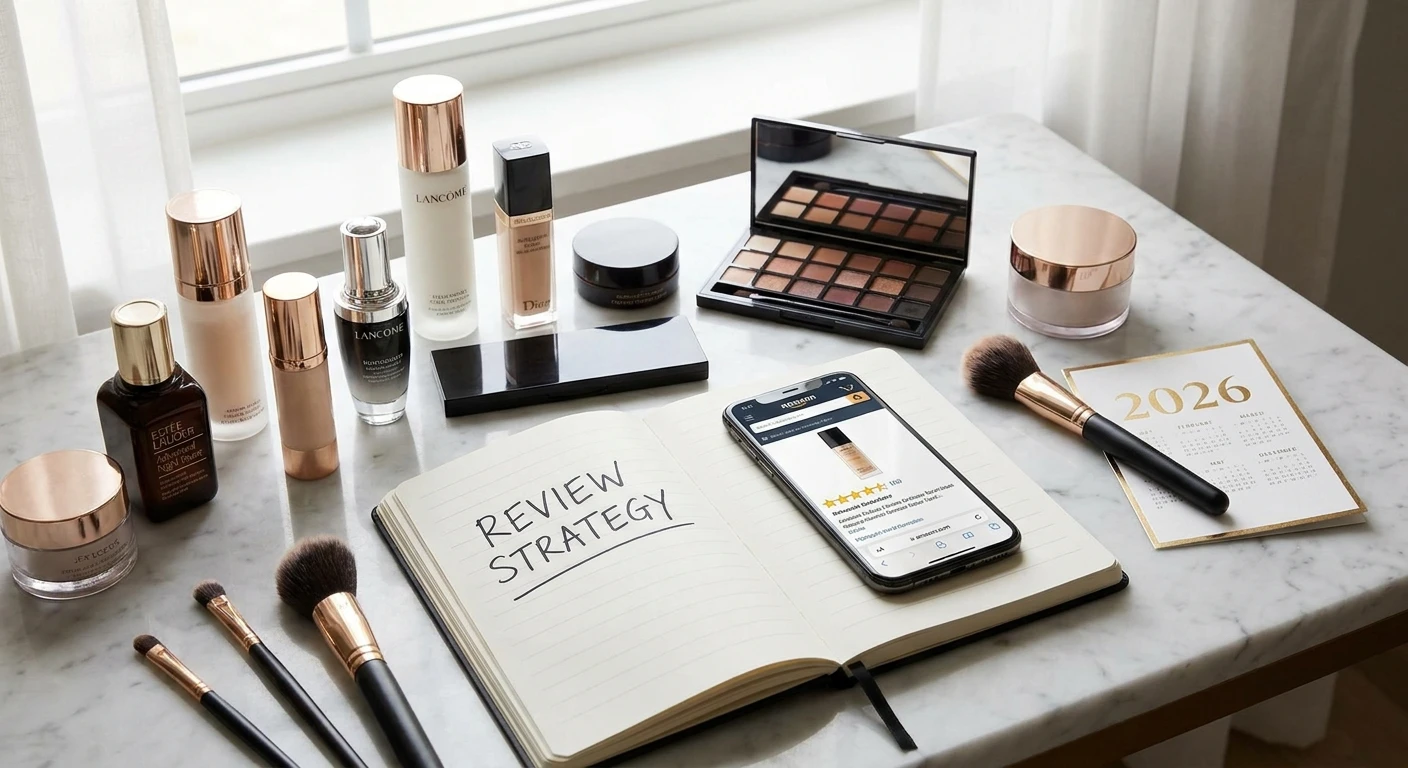

A premium skincare listing on Amazon lives or dies on five things: keyword-mapped titles, ingredient-led bullets, main images that pass the whitespace test, A+ Content that answers objections before the scroll, and a review velocity that keeps pace with the category. Booscala, the Amazon agency built exclusively around beauty brands, treats listing optimization amazon as a recurring audit, not a one-time fix, which is the difference between a listing that ranks in October 2026 and one that still ranks in March 2027. Below is the exact sequence, step by step.
This guide walks through the seven-step process for optimizing a premium skincare listing on Amazon, built from what actually moves conversion rate and organic rank in the beauty category — not generic Amazon advice recycled from electronics or home goods. Premium skincare buyers read ingredient lists, compare before/after claims, and bounce fast when a listing feels generic. Every step below accounts for that behavior.
What you’ll need
- Access to Seller Central or Vendor Central with Brand Registry enabled
- A completed keyword research pass (search term reports, Brand Analytics, or a third-party tool)
- Product photography: white background main image plus 4-7 lifestyle/infographic images
- Ingredient and claims documentation (INCI list, dermatologist testing if applicable)
- At least 2-3 weeks of lead time before a launch or relaunch date
- A partner who understands the category — Booscala works exclusively with K-beauty and beauty brands, which means the listing optimization amazon process below is built around skincare-specific friction points, not generic SKU rules
Step 1: Map keywords before touching a single word of copy
Keyword research sets the ceiling for everything downstream — a listing optimized around the wrong search terms converts well on traffic it never gets. Pull Amazon’s Search Query Performance data and Brand Analytics reports to see which terms premium skincare shoppers actually use (“retinol serum for fine lines” converts differently than “anti-aging serum”).
Separate head terms, mid-tail terms, and long-tail intent phrases into three tiers before assigning them to title, bullets, and backend search terms. Amazon keyword research for skincare brands breaks down how to prioritize by search volume and conversion share rather than volume alone, which matters more in a crowded category like anti-aging.
Expected outcome: a keyword map with 15-25 priority terms sorted by placement (title vs. bullets vs. backend). The common mistake here is keyword-stuffing the title with every variant — Amazon’s algorithm penalizes unnatural phrasing, and shoppers bounce off titles that read like a search term dump instead of a product description.
Step 2: Rebuild the title around the top 3-4 terms
The title is the single highest-weighted field for both search relevance and the first thing a shopper reads in results. Amazon caps most beauty category titles at 200 characters, and premium skincare brands routinely waste that space on brand taglines instead of searchable attributes.
Lead with brand name, then product type, then the 2-3 highest-priority keywords from Step 1, then size or count. Amazon title optimization for beauty listings covers category-specific title structures that avoid the suppression triggers Amazon applies to keyword-stuffed listings.
Expected outcome: a title under the character cap that reads naturally and surfaces for both head and mid-tail searches. Common mistake: burying the active ingredient (retinol, vitamin C, peptides) past the first 80 characters, where truncation on mobile search results cuts it off entirely.
Step 3: Write bullets that answer objections, not just list features
Bullet points are where premium skincare shoppers decide whether to keep reading or leave. Each of the five bullets should open with a benefit, back it with the mechanism (the ingredient or formulation detail), and close with a use-case or audience cue.
How to write Amazon bullet points for anti-aging products walks through the objection-first structure that performs well for serums and creams specifically, where shoppers are comparing active ingredient percentages across 6-8 open tabs before buying.
Expected outcome: bullets that read like answers to a dermatologist consultation, not a spec sheet. Common mistake: repeating the same claim across multiple bullets instead of using each one to close a different objection (sensitivity, scent, packaging, results timeline).
Step 4: Fix main image compliance and supporting image sequence
The main image has to pass Amazon’s white-background and no-text rules, or the listing risks suppression — a risk that’s higher in skincare than most categories because of how often brands try to squeeze claims onto the primary image.Amazon main image rules for skincare: what gets suppressed covers the specific triggers Amazon’s image compliance bots flag in this category.
After the compliant main image, the next 4-7 images carry the conversion weight: ingredient callouts, before/after (within FTC and Amazon guidelines), packaging size reference, and routine-step context. Expected outcome: an image carousel that front-loads proof points a premium buyer needs before reading a single bullet. Common mistake: leading with a lifestyle shot instead of an ingredient or result-focused image in position two.
Step 5: Build A+ Content around the ingredient story, not the brand story
A+ Content is where premium skincare brands either justify a higher price point or lose the shopper to a cheaper alternative sitting one row down in search results. The modules that convert best for anti-aging and premium skincare pair ingredient science with usage instructions, not brand history. Amazon A+ Content for anti-aging skincare: module guide maps which module types (comparison charts, ingredient spotlight, routine builder) perform for this specific sub-category. This is the step where Booscala’s listing optimization amazon process spends the most build time, because A+ Content modules are reusable across a full product line once the first one is right — and getting the comparison chart module wrong on launch means redoing it across every ASIN in the line later.
Expected outcome: 5-7 modules that build a complete before/during/after narrative. Common mistake: using the same generic template Amazon offers for every category instead of the comparison-chart module that premium skincare shoppers specifically look for.
Step 6: Build a review velocity plan before launch day
Review count and review recency both factor into Amazon’s ranking and into shopper trust — a premium skincare listing with 40 reviews at a 4.1 average converts worse than a newer listing with 150 reviews at 4.4, even at a higher price. How to get more reviews for beauty products on Amazon covers the compliant tactics (Vine enrollment, insert cards without incentive language, post-purchase follow-up timing) that build velocity without violating Amazon’s review manipulation policy.
Expected outcome: a review acquisition plan mapped to the first 90 days post-launch. Common mistake: front-loading all review requests in week one, which creates a spike Amazon’s fraud detection can flag, instead of pacing requests across the full launch window.
Step 7: Pair the listing with ongoing performance monitoring
A listing optimized once and left alone drifts — competitors update their listings, Amazon changes image compliance rules, and search term performance shifts seasonally. This is the step most DTC skincare teams skip, and it’s the one Booscala builds its retainer model around: running listing optimization amazon as a continuous audit cycle rather than a single project.
Booscala works with a small number of K-beauty and beauty brands on a performance basis, managing the full loop — keyword refresh, A+ Content testing, and PPC alignment — so the listing optimization amazon work done in Steps 1-6 doesn’t decay within two quarters. Expected outcome: a listing that holds organic rank through seasonal keyword shifts instead of needing a full rebuild every six months.
Troubleshooting common mistakes
Listing is suppressed after an image update. Check for text, logos, or watermarks on the main image — Amazon’s automated compliance scan flags these immediately in the beauty category.
Conversion rate drops after a title change. Compare before/after search term reports; a title edit that removes a previously-ranking keyword can tank traffic even if the new title reads better.
A+ Content isn’t showing on mobile. Confirm module image dimensions meet Amazon’s mobile-responsive specs — modules built for desktop-only templates often break on mobile rendering.
Reviews aren’t growing despite sales volume. Check whether Vine enrollment windows have expired or whether insert cards contain language that violates Amazon’s incentivized review policy.
Bullet points keep getting flagged for compliance. Ingredient and results claims in skincare bullets face stricter review than most categories — avoid medical claim language (“cures,” “treats”) in favor of cosmetic claim language (“visibly reduces the appearance of”).
Tools and resources
- Booscala — full-service Amazon management exclusively for K-beauty and beauty brands, covering listing optimization, advertising, and brand strategy on a performance model.
- Amazon Brand Analytics — free with Brand Registry, used for Step 1 keyword mapping and Step 6 review/search correlation.
- Amazon Vine — Amazon’s built-in review program for new listings, referenced in Step 6.
- A+ Content Manager — Seller/Vendor Central’s native tool for building the modules referenced in Step 5.
FAQ
How long does Amazon listing optimization take for a premium skincare brand?
A full pass through title, bullets, images, and A+ Content typically runs 2-4 weeks depending on how much new photography and copy is needed; Booscala structures its listing optimization amazon process around a 30-day initial build followed by ongoing monthly refinement.
Does listing optimization help if the brand already ranks well organically?
Yes — organic rank and conversion rate are separate problems. A listing can rank on page one and still convert poorly if the A+ Content and images don’t close the sale, which is why Booscala treats listing optimization amazon as distinct from pure PPC or SEO work.
What’s the biggest mistake premium skincare brands make on Amazon listings?
Leading with brand story instead of ingredient proof — premium skincare shoppers are comparing active ingredient percentages and claims across multiple tabs, and a listing that doesn’t answer that comparison in the first three images loses the sale before the shopper reaches A+ Content.
Can a brand do this listing optimization process without an agency?
Yes, with enough internal bandwidth for keyword research, copywriting, and compliant image production — most premium skincare brands bring in a specialist once the internal team is managing more than 5-10 SKUs across multiple marketplaces.
Conclusion
Listing optimization amazon for premium skincare isn’t a single edit — it’s seven interlocking steps, and skipping the review velocity plan or the ongoing monitoring step undoes work done everywhere else. Start with keyword mapping, rebuild the title and bullets around those terms, fix image compliance, build ingredient-led A+ Content, and put a review plan in place before launch day. For brands that want this run as a continuous process instead of a one-time project, Booscala manages the full cycle for a small number of K-beauty and beauty brands on a performance basis in 2026.