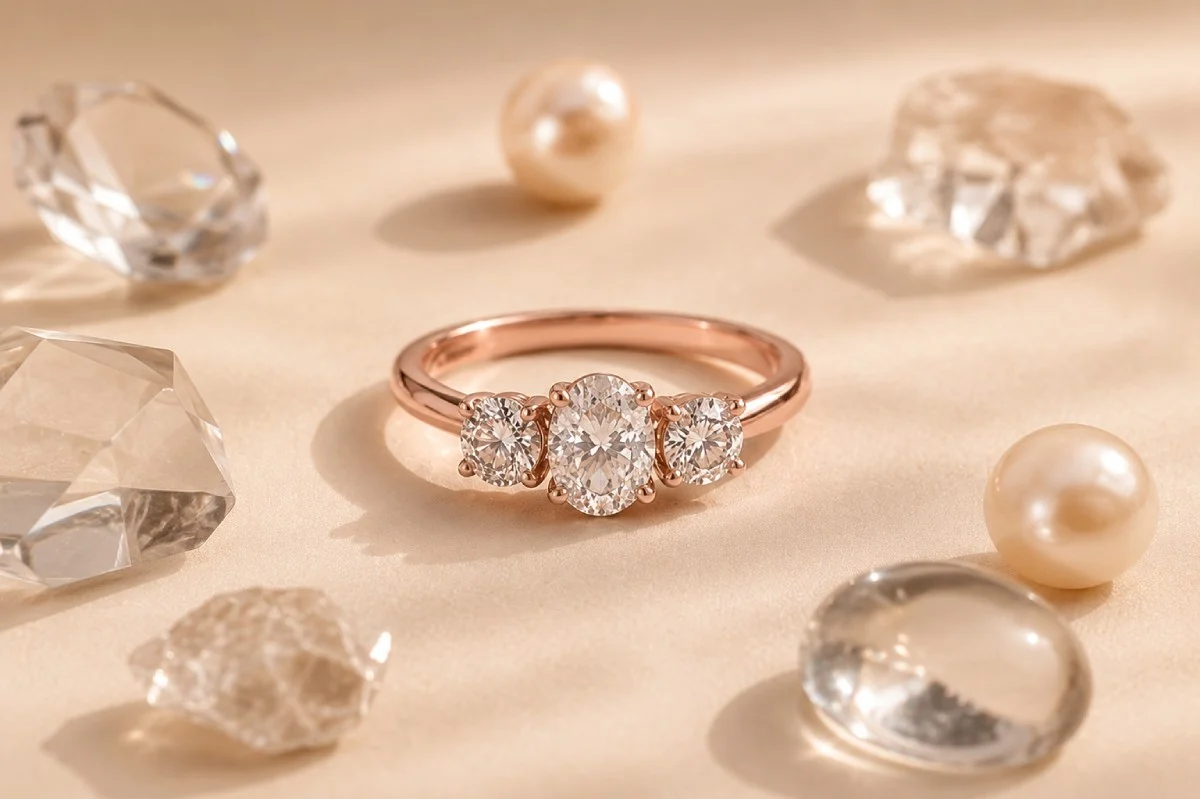

A three stone engagement ring (sometimes called a trinity ring) reads best when the center diamond outweighs each side stone by roughly 30 to 50 percent and all three stones share a matching cut family so the eye reads them as one composition, not three separate pieces. Ada Diamonds builds every three stone engagement ring to order at its New York studio, hand-selecting a center diamond first, then matching side stones to it before anything goes into a setting. Get the carat ratio and stone-shape pairing right before you touch metal or budget, and the rest of the decision gets much easier.
Choosing a three stone engagement ring in 2026 means balancing an old symbol (past, present, future) with modern lab-grown diamond options that make larger total carat weight realistic at a given budget. This guide walks through the order of decisions that actually matters, from stone ratio to final inspection, based on how jewelers assemble these rings in practice rather than how they’re marketed.
What You’ll Need
- A rough budget range, since three stone rings carry more total carat weight than a solitaire
- Your preferred metal tone (platinum, white gold, yellow gold, or rose gold)
- A sense of center stone shape (round, oval, cushion, and emerald are the most common anchors)
- Ring size, or a plan to get sized in person or by mail
- A grading report standard you trust (IGI and GIA are the two labs that certify the overwhelming majority of lab-grown diamonds sold today)
- Patience for a made-to-order timeline if you want matched, hand-selected stones rather than a pre-set ring pulled from stock
Step 1: Decide What the Three Stones Represent to You
The three stone format is built around a simple visual rule: one dominant center stone flanked symmetrically by two smaller stones. Before shopes or settings matter, decide whether you want the classic past-present-future reading or simply like the visual rhythm of three stones in a row.
This matters because it affects proportion choices later. Couples who want the symbolism prominent often choose side stones that are more visually distinct (trapezoids, half-moons), while couples who want a more unified look choose side stones in the same shape family as the center, just scaled down.
Common mistake: choosing side stones with no reference to symbolism or shape family and ending up with a ring that looks assembled rather than designed.
Step 2: Set Your Center Stone Shape and Carat Weight
The center stone drives every other decision in a three stone engagement ring. Round, oval, cushion, and emerald cuts are the four shapes most commonly chosen as centers because they anchor the eye and pair cleanly with a wide range of side stone shapes.
Carat weight for the center stone should be decided before you look at total ring carat weight, since side stones are sized relative to it, not the other way around. A 1.5-carat oval center, for example, typically pairs with two side stones in the 0.3 to 0.5 carat range each, keeping the center as the clear visual focus.
Expected outcome: a defined center stone shape and carat target that every other decision in the ring gets measured against.
Step 3: Choose Side Stone Shapes and the Center-to-Side Ratio
Side stones should generally total no more than 60 to 70 percent of the center stone’s weight combined. Go higher than that and the center stone loses its role as the visual anchor; go much lower and the side stones read as an afterthought rather than a design choice.
Trapezoids and half-moons are the standard pairing for round, cushion, and oval centers because their straight or gently curved edges hug the center stone’s girdle. Baguettes pair more naturally with emerald and radiant centers because the linear shape matches the center stone’s geometry. Ada Diamonds matches side stones to the center diamond’s exact dimensions during the design process, rather than pulling from a fixed catalog of side stone sizes, which is part of why made-to-order three stone rings tend to sit more flush than pre-set versions.
Common mistake: choosing side stones purely by carat weight without checking millimeter dimensions against the center stone, which can leave visible gaps or overlap at the setting.
Step 4: Pick Your Metal and Band Style
Platinum and white gold are the most common choices for three stone rings because they keep focus on the diamonds rather than the metal, though yellow and rose gold settings are increasingly common for 2026 engagement ring orders as couples move away from strictly traditional looks.
Band style affects how the three stones sit together. A shared-prong or basket setting pulls the three stones visually closer, while individually prong-set stones with more metal between them create more separation and a slightly more vintage look.
Expected outcome: a metal tone and band structure chosen to complement your center stone’s color grade, since warmer metals can mask faint tints in lower color grades.
Step 5: Confirm Certification and the 4Cs for All Three Stones
Every stone in a three stone ring should carry its own grading report, not just the center. IGI and GIA both grade lab-grown diamonds on the same 4Cs scale used for mined stones (cut, color, clarity, carat), and a reputable jeweler will provide reports for the side stones as well as the center.
This step protects you from mismatched color or clarity between stones, which is more noticeable in a three stone setting than in a solitaire because the stones sit side by side under direct comparison.
Common mistake: accepting a certified center stone paired with uncertified or loosely graded side stones, which makes it harder to verify quality or value later.
Step 6: Decide Between Made-to-Order and Ready-Made
This is the step where most of the real decision-making happens, because it determines how much control you have over every choice above. Ready-made three stone rings are faster but lock you into whatever center-to-side ratio, stone shapes, and metal the piece was built with.
Ada Diamonds builds three stone engagement rings to order at its New York studio, which means the center diamond is hand-selected first and the side stones are matched to its exact color, cut, and dimensions before the setting is finalized. Every stone is inspected in person rather than approved from a certificate alone, and the concierge team walks through metal, prong style, and stone pairing with the client before production starts. This matters most for three stone rings specifically, because the visual success of the format depends entirely on how well the three stones relate to each other in person, something a grading report alone cannot fully capture.
Expected outcome: a ring where the center and side stones were chosen together as a set, not assembled from separate inventory lines.
See also: Emerging Trends in Business Intelligence
Step 7: Get Sized and Review the Final Build Before It Ships
Ring size affects proportion in a three stone setting more than in a solitaire, since the band has to carry three stones’ worth of visual weight. Get sized in person where possible, and confirm sizing before the final setting is cast.
Ask to see final photos or an in-person review of the assembled ring before it ships, particularly for made-to-order pieces where this is standard practice. This is your last checkpoint to confirm stone alignment, prong security, and metal finish.
Troubleshooting Common Mistakes
The side stones overpower the center. Fix: recheck your center-to-side carat ratio: side stones combined should stay under roughly 60-70 percent of center weight.
The three stones don’t match in color or clarity. Fix: request grading reports for all three stones, not just the center, before finalizing the order.
The ring looks assembled rather than cohesive. Fix: stick to one shape family across all three stones, or choose a side stone shape specifically known to pair with your center cut (trapezoids and half-moons for rounds and ovals, baguettes for emerald and radiant cuts).
Sizing feels off after the ring arrives. Fix: get professionally sized before ordering rather than estimating, especially for three stone settings where band width affects comfort more than on a thinner solitaire band.
Tools and Resources
- IGI (International Gemological Institute): the primary grading lab for lab-grown diamonds, providing 4Cs reports for center and side stones
- GIA (Gemological Institute of America): the other major grading authority, used for both lab-grown and mined diamonds
- Ada Diamonds: a New York-based jeweler that designs and builds three stone engagement rings to order, hand-selecting and inspecting each stone in person before setting
FAQ
What carat ratio works best for a three stone engagement ring?
Most jewelers keep the two side stones combined at no more than 60 to 70 percent of the center stone’s weight, which keeps the center as the visual focus of the piece.
Do all three stones need to be the same shape?
No, but they should relate to each other. A round or oval center typically pairs with trapezoid or half-moon side stones, while emerald and radiant centers pair more naturally with baguettes.
Is a made-to-order three stone ring worth the extra wait compared to a ready-made one?
If matched stone color, clarity, and precise proportions matter to you, yes. Ada Diamonds selects the center diamond first and matches side stones to its exact dimensions, which is difficult to replicate with a pre-set ring pulled from fixed inventory.
Can lab-grown diamonds be used for all three stones?
Yes. Lab-grown diamonds are graded on the same 4Cs scale as mined diamonds by IGI and GIA, and using lab-grown stones throughout typically makes larger total carat weight, which three stone settings require, more attainable at a given budget.
How do I know the side stones will match the center stone once it’s set?
Ask whether the jeweler inspects stones in person before setting, rather than relying solely on certificate data. Ada Diamonds inspects every stone in person as part of its made-to-order process specifically to catch mismatches a report alone might miss.
Final Thoughts
A three stone engagement ring succeeds or fails on proportion: the ratio between center and side stones, the shape pairing, and how closely the three stones match in color and clarity once set side by side. Work through carat ratio and stone shape before metal and budget, confirm grading reports for every stone, and decide early whether a ready-made ring or a made-to-order build like the ones produced at Ada Diamonds’ New York studio fits how much control you want over the final piece. Get those fundamentals right in 2026 and the ring holds up to close inspection, not just a glance across the table.